SACRAMENT
That winter, I practiced saying goodbye to you sliding a finger inside myself
Placing it—knuckle crease to fingertip—down the center of my tongue.
I wanted to know myself—know the woman you might have known. Not sweet
As I would have liked. A chemical quality I might have asked you about, later.
That room with stage props, the giant cardboard dice stacked against dark panes—
Why didn’t you touch me then, talking of surrogacy, your former wife?
I would have, had you asked. No effort to imagine knees inside me, curled,
Thin eyelids, reticulate ears—I’d done it before, four times before—
I mean my body knows its way. I almost believed we might have conjured
A child with our talking, and our silences, as if conception were in rhythm alone. I wept
When I saw bright drops in water, opening slowly, an egg in there, somewhere,
Half the one we might have made—Winter. Summoning your invisible, waiting tongue.
THE ADULTRESS
I asked to meet with your wife
in person, you who protected her
from me—me, mother of four,
ruined breasts in a push-up bra.
I looked at her, and looking,
wanted to expose myself, took off
red nylon outer shell in the cold.
Took off more, down to my
long-sleeved Henley so my flat
belly showed—hers bulging over
belt—and if you hadn’t been
sitting there I might not have stopped
with troublesome zipper, with bra,
shown stretch marks, blue-forked
veins bright with electricity—
ELEVEN TRANSLATIONS OF THE WORD DEPARTURE
1.
Start with Penn Station.
I’d planned to wear jeans, a tasseled wool scarf.
Low-heeled boots to stay under your 5’9”.
(our bodies, how they line up, how they would –)
Beggars in the food court and
your phone to your ear.
You keep it there even after you see me,
my voice in both of your ears
as we press together — (everything,
insteps, shins, shoulders, pressing)
2.
There’s something more – or different.
We walk, your head a dark blur
along the curved tile wall.
(against you)
We look for a train, any train – so long
as the car is empty.
3.
For four years I’ve wondered:
Would I have been the kind of woman
who said, let’s grab a bite first –
ordered soup so hot the skin would curl
from the roof of my mouth?
The kind of woman who refused
your tongue, later?
4.
Go back to the beginning.
Summer in Maine, the empty room, luggage.
The kiss on my forehead.
Then you came back – remember? Asked me
to turn in your keys, your hands
steady. The last time we touched,
your fingertips quivering between
thorns on a stem.
5.
Penn Station, February. Forget the train.
Pull you into a filthy stall,
take you out of the slit in your shorts –
don’t touch, don’t – hold it to my cheek.
Beg me to say the words
I’d typed instead of my lips, tongue.
6.
Tell me the most loving thing,
you wrote. I’m lying beside you on a mountain,
I wrote back. Taking the mountain
inside me – us.
7.
Now the empty car. Seats too wide for one,
too narrow for two. Nothing here
but the straddle, knees bumping armrests,
gray whiskers chafing my chest.
8.
Flaubert’s Acropolis – a come-down!
Like meeting someone you only imagined.
Or maybe it’s all translation.
Lewis says a translator must be chaste, like a nun
driving whores to buy clean needles.
9.
Tell me you’ll be there, you said.
10.
Somewhere between keys and fingertips
you asked me to tell you how things
would be with us.
And where are we in all of this, you said.
I want you to rewrite this, you said.
I want you to change every pronoun.
11.
How would things be with us? he asked.
I would do things differently, I said,
not knowing what I meant.
Next→
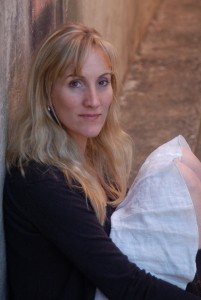 Jamie Quatro’s debut story collection, I Want To Show You More, is forthcoming in 2013 from Grove/Atlantic. Her work has appeared or is forthcoming in The Kenyon Review, Tin House, Ploughshares, The Southern Review, McSweeney’s, Oxford American, and elsewhere. She is the recipient of fellowships from Yaddo and the MacDowell Colony, and was the Borchardt Scholar at the 2011 Sewanee Writers’ Conference. She holds graduate degrees from the College of William and Mary and the Bennington College Writing Seminars, and lives with
her husband and children in Lookout Mountain, Georgia.
